
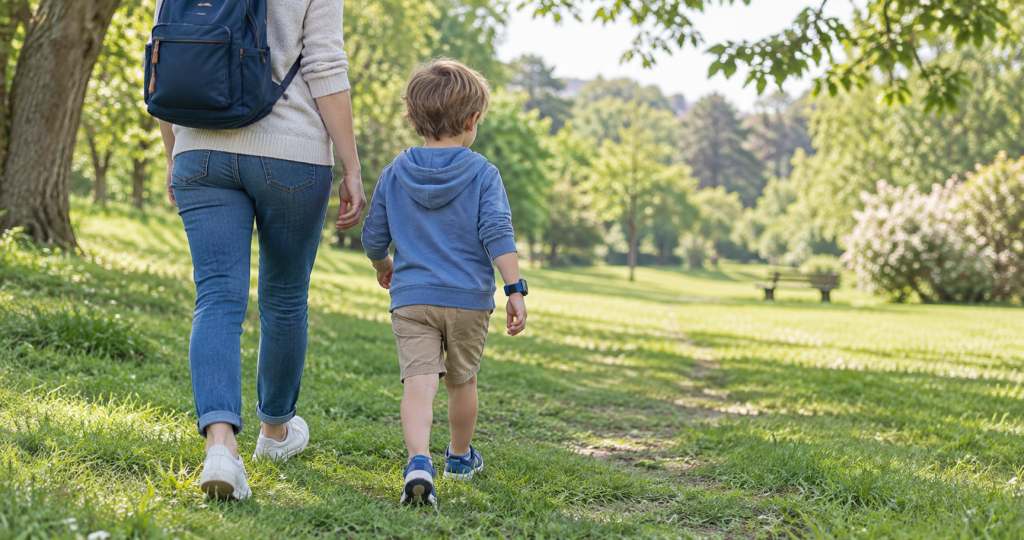
The disappearance of a young child is every parent’s nightmare. Recent events in Suffolk have understandably prompted families across the UK to ask whether toddlers and other vulnerable children should wear some form of location tracker.
Three-year-old Noah Woods went missing after becoming separated from a relative following a visit to a playground in Brantham. Suffolk Police described him as non-verbal, partially deaf and undergoing an autism assessment, meaning he might not respond when his name was called. Police later reported that a child’s body had been recovered from Decoy Pond and that Noah’s family had been informed. Our thoughts are with everyone affected by this tragedy. You can read the official Suffolk Police updates.
It would be wrong to claim that a tracker would definitely have changed this or any other outcome. Every emergency is different, location technology can fail, and no device replaces close adult supervision. However, a suitable tracker may provide another useful layer of protection and a possible starting point if a child suddenly disappears.
Should a Young Child Wear a GPS Tracker?
There is no single answer for every family. A confident older child following a familiar routine may have very different needs from a toddler, a non-speaking child or a child who has a history of bolting or wandering.
A tracker may be worth considering when a child:
- runs off quickly or unpredictably;
- has limited awareness of roads, water or other hazards;
- is non-speaking or may not respond to their name;
- becomes overwhelmed in busy public places;
- travels between home, school and care settings;
- has previously become separated from a parent or carer.
The aim should not be to monitor a child unnecessarily. It should be to reduce the time needed to establish their likely location during a genuine emergency.
GPS Watches, Tags and Tracker Trainers: What Is the Difference?
| Tracker type | How it works | Main advantage | Important limitation |
|---|---|---|---|
| GPS smartwatch | Uses satellite positioning, usually combined with a mobile data connection | Can offer live location, safe zones, calling and SOS functions | Needs charging and often a monthly subscription |
| Dedicated clip-on GPS tracker | Attaches to clothing, a belt or a bag | Small and often simpler than a watch | Can be unclipped, lost or left inside a bag |
| Bluetooth or item-finding tag | Relies on nearby compatible phones or devices to report its location | Small, inexpensive and long battery life | Not true continuous GPS and location updates depend on nearby devices |
| Tracker trainers or insoles | Usually conceal a separate tracker inside the shoe or sole | Less obvious and may stay with the child | The footwear itself may not contain GPS; performance depends on the inserted device |
| Phone location sharing | Uses a child’s smartphone and its built-in location services | No additional wearable may be needed | Unsuitable for many young children and useless if the phone is left behind |
What Parents Need to Know About “Tracker Trainers”
The phrase tracker trainers can be misleading. Some footwear is marketed as GPS-compatible but simply includes a concealed pocket for a separate tag. Before buying, check whether the product actually contains an independent GPS and mobile connection or merely holds a Bluetooth item finder.
Hiding a tracker in footwear has possible advantages. A young child may be less likely to remove it than a watch, and shoes normally remain with the child outdoors. There are still weaknesses: children can remove their shoes, water can damage an inadequately protected tracker, thick materials may affect the signal, and a tag may move inside an uncomfortable shoe.
Never place a hard device where it presses against the foot. Check the fit regularly and stop using it if it causes rubbing, altered walking or discomfort.
Potential Benefits of a Child Location Tracker
A faster starting point
If a child disappears, a recent location may help parents tell the police which direction to prioritise. Even an imperfect position could be more useful than having no digital information at all.
Safe-zone alerts
Some GPS devices let parents draw a virtual boundary around a home, school or play area. The app may send an alert if the tracker leaves that area. Alerts are not always immediate, so they should never be treated as an invisible fence.
Support for children who cannot explain where they are
A non-speaking child, a very young child or someone in distress may be unable to give their address, describe nearby landmarks or ask another adult for help. Location information can provide a separate clue that does not depend on verbal communication.
Reassurance during busy outings
Theme parks, shopping centres, festivals and unfamiliar holiday destinations can become crowded within seconds. A tracker can form one part of a wider family separation plan.
The Limitations Parents Must Understand
Trackers can create false reassurance if families assume that “live location” means perfect, second-by-second accuracy. In reality:
- GPS can be less accurate inside buildings, under dense cover or between tall structures.
- Mobile-connected trackers need suitable network coverage.
- A flat battery turns a tracker into something the app cannot locate.
- Location updates may be delayed rather than genuinely continuous.
- A child may remove, lose or swap the item.
- Some products are water-resistant rather than fully waterproof.
- Subscriptions can expire or payment failures can interrupt service.
Test the device regularly in the places where it is most likely to be needed. Check the battery, app login, mobile connection, alerts and emergency contacts instead of assuming that yesterday’s setup still works.
Bluetooth Tags Are Not the Same as GPS Trackers
Small Bluetooth item finders can be useful for keys, luggage and bags, but they do not work like a dedicated child GPS watch. Their ability to report a distant location generally depends on other compatible devices passing nearby.
Apple states that AirTag was designed to help locate personal belongings rather than track people. It also includes unwanted-tracking protections that can alert someone when an unfamiliar tag is moving with them. Read Apple’s explanation of AirTag safety.
A Bluetooth tag may provide an additional clue, especially in a busy area with many phones, but parents should not mistake it for a guaranteed live child-location service.
Children Who Wander or Have Additional Needs
Some autistic children and children with other developmental differences may leave a safe area for many reasons: curiosity, seeking a favourite place, escaping noise, distress, impulsivity or limited awareness of danger. The behaviour is not the child being “naughty”, and families should not be blamed when it occurs.
Technology should sit within an individual safety plan. Depending on the child, that plan might also include:
- a recent photograph and up-to-date physical description;
- an identification card or wristband with a trusted adult’s number;
- door and gate alarms at home;
- a written plan shared with school, relatives and carers;
- information about favourite places, water, trains or other attractions;
- a comfortable wearable the child has practised wearing;
- age-appropriate water-safety and road-safety teaching.
Sensory comfort matters. A watch that feels tight, vibrates unexpectedly or makes unfamiliar sounds may be removed immediately. Introduce it gradually and consider a shoe pocket or securely attached tracker only if that is comfortable and safe for the individual child.
A Tracker Cannot Replace Water Safety
Ponds, rivers, canals, reservoirs and other open water require particular caution. A location dot near water does not show whether a child is safe, and a delayed alert may arrive too late to prevent an emergency.
The Royal Society for the Prevention of Accidents provides guidance on protecting children around water. Active adult supervision, secure barriers where appropriate and teaching children about water hazards remain essential regardless of whether a tracker is worn.
Privacy and Security Questions to Ask
A child’s regular location is sensitive information. Before buying a tracker, parents should ask:
- Who can view the child’s location?
- Is location history stored, and for how long?
- Can approved contacts be controlled by the parent?
- Does the account support a strong, unique password and two-step verification?
- Can strangers call or message the device?
- How can the child’s data be deleted?
- Does the company clearly explain what happens if the service closes?
The UK Information Commissioner’s Office has emphasised strong privacy protections for children, including high-privacy defaults and careful handling of geolocation. Read the ICO’s child-privacy priorities.
What to Do If a Young Child Goes Missing
If a young or vulnerable child disappears and may be in immediate danger, call 999. Tell the police about any nearby water, roads, railways, building sites or other urgent hazards.
- Give the child’s name, age, description and clothing.
- Explain any communication needs, hearing difficulties or likely response to strangers.
- Share the last confirmed sighting and direction of travel.
- Open the tracker app and preserve screenshots of the latest location and time.
- Tell officers about favourite locations, routines and things that may attract the child.
- Provide a recent clear photograph.
- Follow police directions and do not enter dangerous water, railway lines or other hazardous areas yourself.
Do not spend valuable time troubleshooting a tracker before contacting emergency services. The device is supporting information, not a reason to delay reporting the child missing.
Pros and Cons of GPS Trackers for Young Children
Possible advantages
- May provide a recent location
- Safe-zone and separation alerts
- Useful for some non-speaking children
- Can support a wider safety plan
- Some models include calling or SOS
Possible disadvantages
- Battery, signal and accuracy limitations
- May create false reassurance
- Privacy and data-security concerns
- Possible subscription costs
- Can be removed, lost or damaged
Our Verdict
For some families, particularly those caring for a very young child or a child who may wander, a genuine GPS tracker is a reasonable extra precaution. The best option is one the child will comfortably keep on, that parents test frequently and that provides clear information about coverage, battery life and data privacy.
Tracker trainers, watches and tags all have weaknesses. None should be described as making a child completely safe. The most responsible approach combines attentive supervision, physical safety measures, an emergency plan and suitable technology where it genuinely helps.
Frequently Asked Questions
Can I put a GPS tracker on my child in the UK?
Parents commonly use location-enabled watches and trackers as a safeguarding aid for their own young children. Use the information responsibly, limit access to trusted adults and consider the child’s age, understanding and privacy as they grow.
Are AirTags suitable for tracking children?
AirTags are designed for belongings, not people. They may occasionally provide a location through nearby Apple devices, but they are not a substitute for a dedicated GPS child tracker with a mobile connection.
Do tracker trainers contain GPS?
Some may, but many simply provide a hidden space for a separate tracking tag. Read the product description carefully and confirm whether the system uses true GPS, mobile data, Bluetooth or a crowdsourced finding network.
Will a GPS tracker work without mobile signal?
The tracker may still calculate its position from satellites, but it usually needs a mobile or internet connection to send that location to the parent’s app. Behaviour varies between products.
Which is better: a tracker watch or a hidden tracker?
A watch can provide communication and emergency features, while a concealed tracker may be harder to remove. The better choice depends on the child’s sensory needs, age, likelihood of taking it off and the specific device’s reliability.
Can a tracker prevent a child from going missing?
No. A tracker cannot physically stop a child leaving or guarantee an accurate location. It may help locate them more quickly, but it must remain only one part of a broader safety plan.
Further Reading and Sources
- Suffolk Constabulary: official updates concerning Noah
- RoSPA: keeping children safe around water
- Information Commissioner’s Office: protecting children’s privacy
- Apple: AirTag and unwanted-tracking protections
This article provides general information for UK parents and is not a guarantee of safety or a substitute for emergency-service advice.
